About Me:
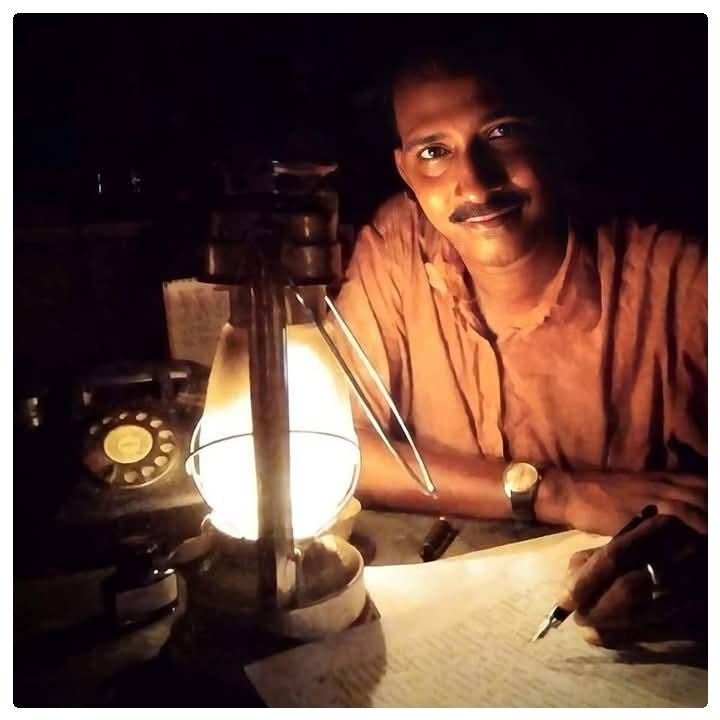
I am Debasish Acharjee, a natural dyer based in Bolpur–Santiniketan, West Bengal, India—a place known for its rich cultural heritage, traditional crafts, and the legacy of Rabindranath Tagore, who established Visva-Bharati here.
Through my work, I represent Bengal Natural Dyeing (পল্লী বাংলার প্রাকৃতিক রংরেজি)—a small, independent practice rooted in the soil, history, and traditions of rural Bengal.
My Journey:
My path to natural dyeing has not been direct, but deeply connected through learning and experience. I studied Botany, Rural Technology, and Pharmaceutical Sciences, which helped me understand plants, materials, and their interaction with the human body.
I worked for 15 years as a hospital pharmacist, followed by 5 years in telemedicine, engaging in real-time and evidence-based healthcare.
Over time, my interest shifted toward regional history and forgotten local narratives. During my independent research, I began helping descendants of people from the British India period trace their historical roots—exploring old houses, cemeteries, and archival traces.
In 2019, this journey led me to meet Mr. George Hennessy and his family, descendants of an indigo planter and zamindar of the Mathurapur Indigo Concern in Maldah, West Bengal. Along with Mrs. Lucy Hennessy Kennedy and Mrs. Amy, they became a turning point in my life.
Their ancestral connection to indigo and lac—both natural dyes—deeply inspired me. From that moment, I began my journey into natural dyeing in 2020.
Since then, I have been continuously practicing and refining this work.
My Work & Process:
At Bengal Natural Dyeing, I follow dyeing methods that were practiced in Bengal during the 18th and 19th centuries by native dyers.
I do not use any industrial chemical mordants
I rely entirely on natural dye sources and traditional techniques
I use solar energy for heating, avoiding fossil fuels such as gas, wood, or coal
I work with cotton, silk, and jute—both yarn and fabric.
I focus only on dyeing, not garment production.
This is a one-person practice. Every step—from sourcing to dyeing—is done by me with care and attention.
Philosophy & Belief:
I believe that what we wear is not separate from our body.
Textile dyes can come into contact with our skin and may influence our well-being.
For this reason, I follow a principle:
Dyes should be as natural and safe as the food we consume.
I use natural mordants as practiced centuries ago, ensuring that the entire process remains in harmony with nature.
My approach is built on a simple but firm commitment:
Zero chemical impact
Zero fossil fuel use
Zero waste
After dye extraction, all natural residues are converted into vermicompost fertilizer, returning back to the soil.
This creates a closed, sustainable cycle, where nothing is wasted and everything is respected.
Purpose
My work stands at the intersection of:
Livelihood
Preservation of traditional knowledge
Historical research on natural dyeing
Environmental sustainability
Personal passion
Through this practice, I hope people reconnect with the value of natural processes, and understand that sustainable living is not new—it has always existed in our traditions.
This Website:
This website is not a marketplace.
It is a living record of my work.
Here, I share:
My daily natural dyeing activities (lifelog)
Process documentation
Research notes, data, and results
It is an open journal for anyone interested in understanding natural dyeing in its true, working form.
Closing Thoughte:
Bengal Natural Dyeing is not just a practice.
It is a quiet return—to nature, to history, and to mindful creation.
 Bengal Natural Dyeing